what’s the plural of diagnosis?

For my family, the first time I had cancer was total shock and awe, but for me, I’d simply followed self-examination instructions and hit the jackpot.

Sitting in the bath on Good Friday evening 1991, the lather parted on my left breast to reveal a marshmallow-sized lump. A strange calmness washed over me as I greeted my destiny

“Oh, so that’s it then”

I didn’t share my discovery with anyone until I saw the doctor four days later.

What followed were days and weeks of worry. Biopsy and lumpectomy surgeries, six weeks of radiotherapy, and all the sleep I could muster. I filled the freezer and labelled each bag with clear instructions.

I was thirty-six years old. I’d just miscarried a desperately wanted baby. My unsupportive marriage was crumbling around me, and in a set of circumstances worthy of Mills & Boon fiction, I’d begun the most unexpected love affair. There wasn’t much time to think about my cancer; so I didn’t.

My family were spared an immediate response to my second diagnosis five years later, because my dad was dead, my brother living abroad, and it was the eve of my wedding day.

When the consultant faltered reading the biopsy results, Mark and I knew our pre-nup was going to be more Sickness than Health.

After biopsy surgery the previous week, I’d modified the low neckline of my wedding outfit; the only thing now required was the ability to keep a secret, a large smile and a larger drink.

We did all three with aplomb, and even kept the smiles in place through our three-day Devon honeymoon. When we returned home to face the music, we drove very slowly.

What followed were days and weeks of worry, a mastectomy, six months chemotherapy, a second mastectomy with bi-lateral reconstruction, and all the sleep I could muster. I planted fast-growing flowers and wondered how many I would pick.

My dad had died suddenly within a week of my uncle (swiftly followed by my beloved cat), my mum needed all the support I could give. I’d just got married and there wasn’t much time to think about my cancer; so I didn’t

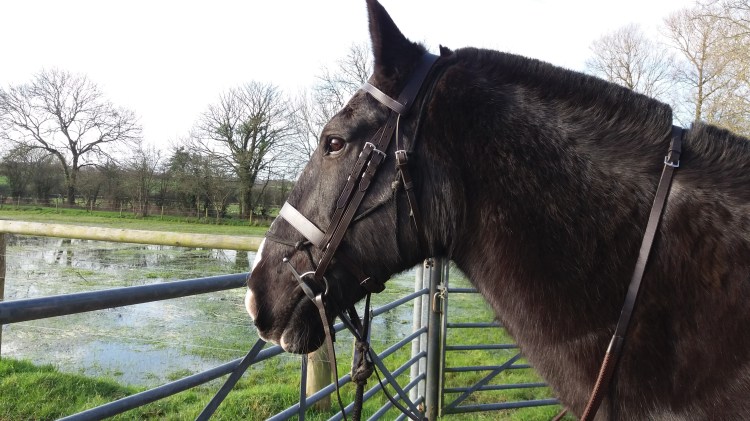
With a nine year interval, there was even less family to herald the arrival of cancer number three. After beating breast and bowel cancer, my lovely mum suffered a devastating heart attack and never recovered. I‘d just made the heart-wrenching decision to have my horse put down at the ripe old age of twenty-three. Comfortably numb, there was no emotion left when a routine check-up located a lump in my armpit.

Worry, two rounds of surgery, a massive allergic reaction to the anti-cancer drug Tamoxifen, sleep. I gave up gardening and bought ready meals for the freezer.

Deeply mourning mum’s tragic death, desperately missing the magical bond of horsiness, reeling from my sister-in-law’s diagnosis of terminal liver cancer, and supporting a friend battling leukaemia- there REALLY  wasn’t much time to think about my cancer. And I didn’t.

Not until the fourth diagnosis did all that not-thinking come back to bite me. . .

requisitioned

(a blue sky dream)

The sky, in his dream,

was a porcelain shade of English blue.

The grass, although not verdant

was sweet, short

and instantly fresh against his jaded tongue.

The air,

which he barely had time to scent

so busy was he eating,

cooled nostrils blackened with fire

and a throat full of death dust.

The ground soft yet firm

didn’t hold his tread,

but released a foot to fall

where ‘ere it chose.

No crunch of bones

in the turf of ancient meadows.

Groans and screams,

and cries of writhing pain

were drowned by songs of birds,

and the lice itching his tender skin

became amiable scratches

against the orchard trees,

in this blue sky dream.

Awake, he bent his head.

The scorched earth mocked

his sleeping haven,

and the noise,

body parts and blood

told another story,

too terrible to translate.

He blew softly.

The scarcest outlet of breath was heard

amid cannon fire commotion,

but a hand  (one he knew)

came instantly to his side,

resting awhile open-palmed on his neck,

gentle as his mother once was

when she licked him clean and warm.

Together in a moment

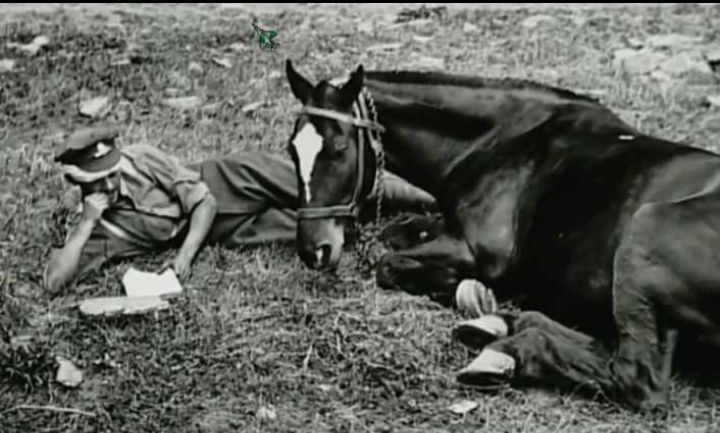
a horse, his soldier,

steadying one another.

Carrying one another

into the final ride of death,

without glory or recognition

under that imaginary

blue English sky.

for Lilith

photo of Pearl courtesy of Anna Blake

St Peter stands at heaven’s front door, but if you pop round the back you’ll find the best bit – its where the horses are.

I’m not one for finding comfort in Rainbow Bridges (horses are such patient beings in this world, please don’t make them wait on us in the next) or Stars in the Sky, because stars are awesome enough as they are, but I know in my heart of hearts that when horses die, they go to a special place where fields are wide and flies are few, and they can breathe and snort and simply be horses, and things no longer hurt.

Here, sad horses exchange skin and bone for sleek coats and strong limbs. Skinny mules from Egypt grow plump, and the best loved horses become more best and even more loved. As they walk through heaven’s wide gates where Anna Blake’s Grandfather Horse, and Mark Rashid’s ranch horse Buck graze the lush green grass, newcomers are welcomed with a quiet nicker and a gentle breath.

Through this gate tottered a curmudgeonly little donkey named Lilith; small in stature but grand in stance. Her eyes were cloudy and her hearing muffled; she could no longer see or hear the inhumanity meted out to donkeys everywhere. God’s grazing herd recognised a Very Special Being, and respectfully lined her route home.

Lilith glanced left and right. With a slight drop of the nose towards Grandfather horse, and a long-ear flick towards Buck, she wobbled unsteadily down the centre of the assembled horses. As cantankerous in death as she was in life, she threatened to kick or bite anyone who stepped out of line.

When she reached the bucket of tinned pears (her toothless favourite) she stopped and sniffed, gathered her frail body into a semblance of order, and thought about braying. Then she buried her nose in the nectar of Heaven and ate to her heart’s content.

inspired by Crissi McDonald

INSPIRED by CRISSI McDONALD

What if we stopped berating our past mistakes?

What if we changed the narrative and called them progress?

All of us here have travelled long and far. Not just with our horses but with our selves.

Our faults are many, our successes few, and in order to improve we beat ourselves with that large stick of past failures, in a way we would never beat our horses.

But what if every mistake, every error of judgement was merely a rung on the ladder to learning. Surely that can’t be wrong?

Perhaps, with the benefit of hindsight (which is a land where everything shines unicorn clear) we simply had that ladder against the wrong wall?

Along our Damascene Roads, many of us got more involved in techniques than proved good for our horses – or ourselves- but just like adding our own pinch-of-this –and-that to season a textbook recipe, none of us can deny sprinkling a tad of past learning on today’s actions.

I was raised on tried and tested British Horse Society principles; followed by millions, but falling short of the ‘right’ meaning for me.

However much I disagree with a lot of the teaching, I still apply basic BHS learning to every horse I encounter, every day, and my standard of horse care is just as Major Browne taught me all those years ago at Pony Club. I check water buckets and feed bowls for snot or blood. I shut the gate behind me when turning out to pasture. I thank motorists for slowing down and passing with a wide berth. Could Parelli have taught me these basics? Could I have learnt them in a round pen? So BHS wasn’t all bad.

Regret for horses bewildered by our mistakes is understandable, but can we say it won’t happen again?

To have caused anguish to those we love the most, is as big a sin as we can commit but we didn’t do it maliciously; we were doing the best we could with what we knew at that time.

Each day we take our horse’s demeanour in the present tense, so let us do the same for ourselves!
Collect all our past horse history into a large heap, and celebrate just how large it is. Look how far we’ve come, look what we’ve experienced! Look at how much we can rationally discuss, and teach others, because we WERE THERE.

Treat it all as learning. When the larger picture is blurred, see the tiny increments we made on our way to celebrating we’re still here, relatively sound and able to breathe with horses.

Because what it all comes down to is that we’ve spent a lifetime learning to breathe.

Which was right under our noses all along.

a girl,a woman,or a lady?

“Are you a girl, a woman or a lady”?

Oh, that’s a real easy question to answer I thought, because I’ve always been a girl, see-sawing somewhere between Scarlett O’Hara and Calamity Jane. I get my way with girlie smiles or a lady’s raised eyebrow (never womanly wiles), and tackle chores and problems with girlie gusto, wearing lace-trimmed cut-offs and boots, and swearing like a trooper. Quite unladylike. A girle tomboy.

My friends are generally girls. Except for horses and dogs that are better suited as boys. Gay men friends are girlier than my girlfriends, and although none of us are pink sparkly people, we love pink champagne.

Pixie-cut hair is girlie glamour, even when staunchly grey. Once it tumbled in curls, but youth is gone and girls do not dwell.

Clothes? Clothes are fun and functional with two fingers defiantly raised to fashion. ‘Classic with a twist’ – a mere pseudonym for oddly placed fastenings- and anything matchy-matchy are a no-no.

Then I got to thinking more, and applied Anna’s five-word creative writing test.

GIRL: Cute. Sassy. Friend. Jeans. Free.
WOMAN: Hourglass. Poise. Motherly. Grown-up. Career.
LADY: My mother.

Women frightened me. The criteria of poise and confidence seemed just out of reach for a girl, but lately things have shifted.

Between plucking and smoothing, I look in the mirror and I feel I am enough. It’s womanly in a very grounding, nurturing way which isn’t what I expected. Motherliness is more like sisterliness, my career somewhat ad-hoc, but confidence comes when I trust my girlishness. Moreover, if poise means equilibrium, then yes, without reaching I have that too.

“No, I’m not available to do that” is something I can say without the addition of a thousand apologies, because actually, I don’t give a damn if they don’t like me.

I thought being a woman meant damping down girlie enthusiasm, like following a recipe instead of improvising potluck leftovers. Now, I discuss politics over the potluck supper, and quite I often I don’t say anything because silence says infinitely more.

And I no longer show up at every fight I’m invited to.

Wonder Woman? Not quite, not yet. But I think she’ll join me for a glass of chammy.

PS which one are you?

mouth before brain

It happened again. And again before that, and when you think back, there’s a whole history of agains.

Each time, you say “I will never do that again”

Then you do; at least there is consistency.

Why, after so much practice (and so much regret) you still fail to recognise the point where you could have stopped?

Words fill your mouth. You forget just because you taste them, you don’t have to say them.

Gulp, bite your tongue, or even smile through gritted teeth.

But no, you go for the kill. Death by home-truths, AKA Some Things Are Better Left Unsaid.

There are myriad reasons for saying what you said. In the darkness of night, between sighing and craving sleep, you try, try, and then try some more to find justification. You justify until dawn, and by morning, you have almost reached absolution. Almost, but not quite.

Daylight reckoning doesn’t fare much better. Thoughts churn continually, until the real reason behind what you said – ‘What Happened Before What Happened Happened’- is laid clear and bare. And it and aint pretty.

The words, and the person who received them, are collateral damage. Unfair, unkind, but shamefully true. The words were all about you.

see me

The layered scars,

bestowed along years of treatment

would tell their own story

if only I could let them.

But the cutting removing

re-arranging and healing

are neither sights nor tales

for the faint of heart,

and my cancer is not yet public property.

I don’t want your sorrow.

Don’t wear pink for me

and run marathons in my name

because my life, (what’s left of it)

is not yours to pity.

I’m the same bitch I’ve always been,

I still laugh at misfortune and

swear freely without shame.

Cynicism sharpened by poison.

See me

before you see the cancer.

See the curly hair even when I’m bald

and the smile flying at half mast.

See the mismatched-on-purpose clothes

and the defiance

lingering behind my eyes.

See the terror, the pain and the loneliness

separating terminal

from curable.

Rest with me in my silences.

See me pleading for time that you take for granted

but see me first.

I am not your drama

you cannot steal me.

I am not a crutch enabling your betterment

and I have no silver lining.

I’m the bad news you wish you hadn’t met,

sent to spoil your healthy day

but in my way, I’m happy.

I see joy where you cannot.

Love, birdsong, friendships, kindness

are spread so thickly on my slice of life

that I grow fatter each day

in the moment of every mouthful.

And the best? I save that for dessert.

I am not yet dead

changing narrative

In my Loving Kindness group, I posed a question about feeling resentful after backing down from an awkward situation.

The man sitting opposite me said “Changing the narrative could mean that instead of feeling forced into a decision, it becomes your choice.”

Is changing narrative as easy as seeing silver linings under clouds, or seeing a new door when the familiar exit shuts, or is that over simplification?

Is changing narrative as easy as re-naming unwanted behaviour, calling an expensively priced dog a Terricolliedoodle instead of a mongrel, or announcing a train is unavoidably delayed when its downright late. Or is that Positive Spin; a job with a lofty title and equally high salary?

Jon Kabat Zinn, Professor Emeritus of all things Mindful, leads us to focus on breathing while imagining sky and clouds. Thoughts are not our mind; they are merely clouds that we can un-hook and allow to float away, which is an extremely useful narrative change for shedding anxiety.

Mindfulness in any form doesn’t just change the narrative chimp, it positively dismisses it and asks that instead we simply notice. Simple yes, but not easy.

Is changing narrative something that needs to be learnt and practised, or do we absorb its use from others, to apply ad hoc. If changing narrative reveals a different perspective, does that make every life event a moveable feast, and problems only problems because that’s what we call them? Can we actually alter a situation by approaching it differently, or are we sidestepping what is plainly obvious in order to avoid misery. Do we ever change narrative of a happy or satisfying event?

If changing narrative is a practised skill with its own rules and limitations, where exactly are those limits?

Medication is an interesting example. Does medication change a narrative?

Our body and mind tells us we’re depressed and anxious. Some meds flood mood-changing Serotonin while others act on nerve patterns. Are they saving us the agony of climbing out a pit that feels too deep to scale, or are we silencing a narrative that’s desperate to be heard.

Would traumas be better if we re-named them Creative Sources? Would those of us needing to release the pressure of what we carry inside, be as empathetic with our creative output, if we led the lives we change narrative to create?

Does a heart by-pass change a hopeless narrative, cancer treatment a dire one- when ‘incurable’ becomes a synonym of ‘terminal’ what exactly does it change?

A strong belief in religion or spirituality, or even a nod to something more forceful, can change the narrative from ours to theirs. Will reading an ancient tract or repeating a mantra provide a different perspective, or just give permission for a current one, however heinous that may be?

For most of my adult life I’ve been fighting an illness I can’t beat; tenacity has become second nature. I’ve been asked many times for my secret, and I’ve always shrugged and suggested I must be very lucky.

It wasn’t until I properly- PROPERLY- began noticing how much I change narrative to lessen the burden, that I saw it as the tactic that saves my sanity.

Yes, it’s a good way to avoid the enormity of unavoidable truths, but it’s also a good way to accept them with equanimity. We don’t have to like everything, but neither do we have to shoulder too-heavy burdens. Invest in a trolley-on-wheels and carry them alongside. Forget them entirely when the terrain is difficult, secure in the knowledge they’ll find their own way home.

Perspective, changing narrative; you can’t change a situation but you can change the way you look at it.